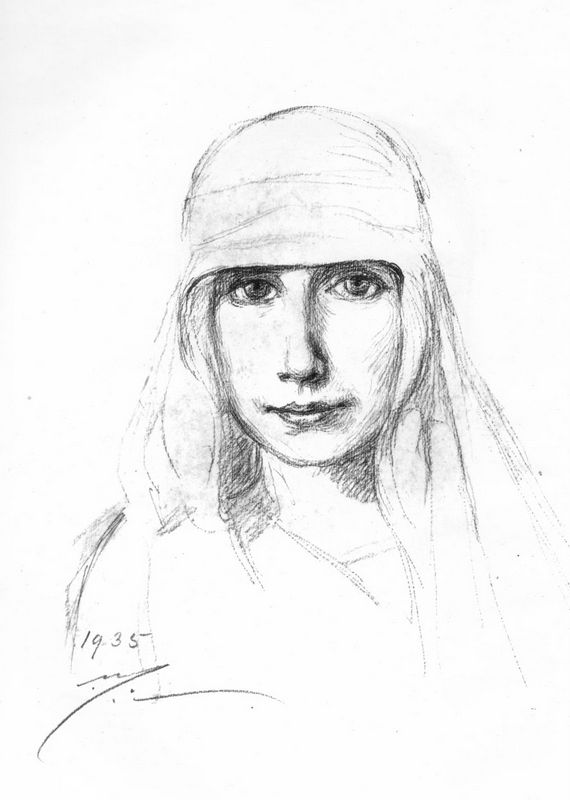
Self-portrait
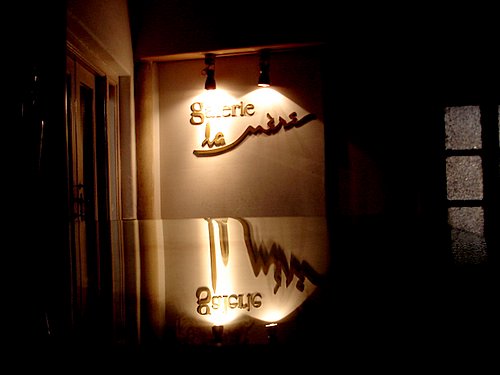
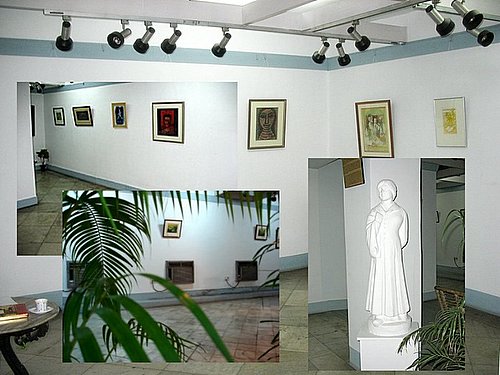
Galerie La Mère is named after The Mother and was opened in homage to the Divine Artist.
The Mother once said that She began to draw at the age of eight and started to learn oil painting and other painting techniques when She was ten. She added on another occasion that at twelve She was already doing portraits.
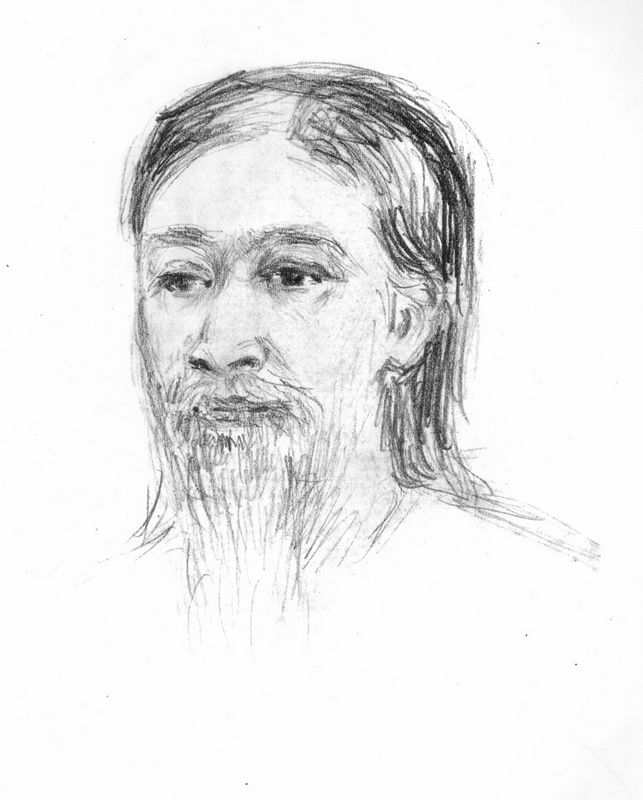
Sri Aurobindo's portrait
The Divine puts on an appearance of humanity, assumes the outward human nature in order to tread the path and show it to human beings, but does not cease to be Divine. It is a manifestation that takes place, a manifestation of a growing divine consciousness, not human turning into divine. The Mother was inwardly above the human even in childhood...
- Sri Aurobindo
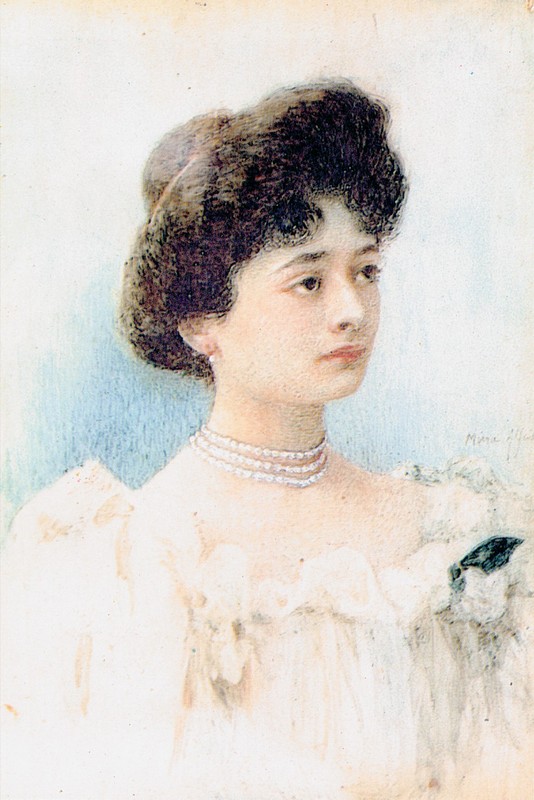
Plate 29: This portrait of Mme Valentine is done on a small piece of ivory (1897). The Mother presented it to Ms. Maggi Lidchi, one of her disciples, in whom she recognised a reincarnation of her friend. Mme Valentine, a close friend of the Mother's during her days in the art studio, died in childbirth just before the Mother's son, Andre, was born.
Music and Painting fascinated me
All aspects of beauty, but particularly music and painting, fascinated me. I went through a very intense vital development during that period, with, just as in my early years, the presence of a kind of inner Guide; and all centered on studies: the study of sensations, observations, the study of technique, comparative studies, even a whole spectrum of observations dealing with taste, smell and hearing - a kind of classification of experiences. And this extended to all facets of life, all the experiences life can bring, all of them - miseries, joys, difficulties, sufferings, everything - oh, a whole field of studies! And always this Presence within, judging, deciding, classifying, organising and systematising everything.
The Mother's script of the Artist in 'The Great Secret'
'The Great Secret' - a play by The Mother.
Six Monologues and a Conclusion
Six of the world's most famous men have been brought together, apparently by chance, in a life-boat in which they have taken refuge when the ship that was carrying them to a world conference on human progress sank in mid-ocean.
There is also a seventh man in the boat. He looks young or, rather, ageless. He is dressed in a style belonging to no period or country. He sits at the helm, immobile and silent, but listens attentively to what the others are saying. They treat him as a nobody and take no notice of him.
The persons are:
- The statesman
- The Writer
- The Scientist
- The Artist
- The Industrialist
- The Athlete
- The Unknown Man
Water is running out, provision have come to an end. Their physical suffering is becoming intolerable. No hope on the horizon: death is approaching. To take their minds off their present miseries, each one of them in turn tells the story of his life.
The persons are:
- The statesman
- The Writer
- The Scientist
- The Artist
- The Industrialist
- The Athlete
- The Unknown Man
Water is running out, provision have come to an end. Their physical suffering is becoming intolerable. No hope on the horizon: death is approaching. To take their minds off their present miseries, each one of them in turn tells the story of his life.
Extract from: The Mother > Dramas > The Great Secret
The Artist
Born into a thoroughly respectable bourgeois family where art was considered as a pastime rather than a career and artists as rather unreliable people, prone to debauchery and with a dangerous disregard for money, I felt, perhaps out of contrariness, a compelling need to become a painter. My entire consciousness was centred in my eyes and I could express myself more easily by a sketch than in words. I learnt much better by looking at pictures than by reading books, and what I had once seen - landscapes, faces or drawings - I never forgot.
At the age of thirteen, through much effort, I had almost mastered the techniques of drawing, water colour, pastels and oil painting. Then I had the chance to do some small commissions for friends and acquaintances of my parents, and as soon as I earned some money, my family began to take my vocation seriously. I took advantage of this to pursue my studies as far as I could. When I was old enough to be admitted, I joined the School of Fine Arts and almost immediately started taking part in competitions. I was one of the youngest artists ever to win the 'Prix de Rome' and that gave me the opportunity to make a thorough study of Italian art. Later on, travelling scholarships allowed me to visit Spain, Belgium, Holland, England and other countries too. I did not want to be a man of one period or one school, and I studied the art of all countries, in all forms, oriental as well as occidental.
At the same time I went ahead with my own work, trying to find a new formula. Then came success and fame; I won first prizes in exhibitions, I sat on juries, my paintings were shown in the leading museums of the world and snatched up by the art dealers. It meant wealth, titles, honours; even the word "genius" was used... But I am not satisfied. My conception of genius is quite different. We have to create new forms, with new methods and processes, in order to express a new kind of beauty that is higher and purer, truer and nobler. So long as I still feel bound to human animality, I cannot free myself completely from the forms of material Nature. The aspiration was there, but the knowledge, the vision was lacking.
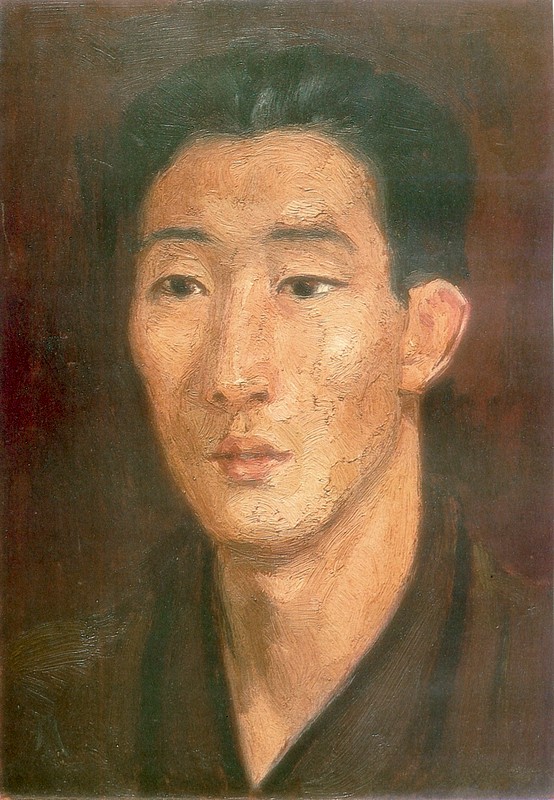
Plate 30: Portrait of Japanese Poet Hirasawa Tetsuo (1916-20). It was done in one sitting. Hirasawa later visited the Mother in Pondicherry (October 1924).
The discipline of Art
The discipline of Art has at its centre the same principle as the discipline of Yoga. In both the aim is to become more and more conscious; in both you have to learn to see and feel something that is beyond the ordinary vision and feeling, to go within and bring out from there deeper things. Painters have to follow a discipline for the growth of the consciousness of their eyes, which in itself is almost a Yoga. If they are true artists and try to see beyond and use their art for the expression of the inner world, they grow in consciousness by this concentration, which is not other than the consciousness given by Yoga.
......
There is a considerable amount of difference between the vision of the
ordinary people and the vision of the artists. Their way of seeing
things is much more complete and conscious than that of ordinary people.
When one has not trained one's vision, one sees vaguely, imprecisely,
and has impressions rather than an exact vision. An artist, when he sees
something and has learned to use his eyes - for instance, when he sees a
figure, instead of seeing just a form, like that, you know, a form, the
general effect of a form, of which he can vaguely say that this person
resembles or does not much resemble what he sees - sees the exact
structure of the figure, the proportions of the different parts, whether
the figure is harmonious or not, and why; and also of what kind or type
or form it is; all sorts of things at one glance, you understand, in a
single vision, as one sees the relations between different forms.
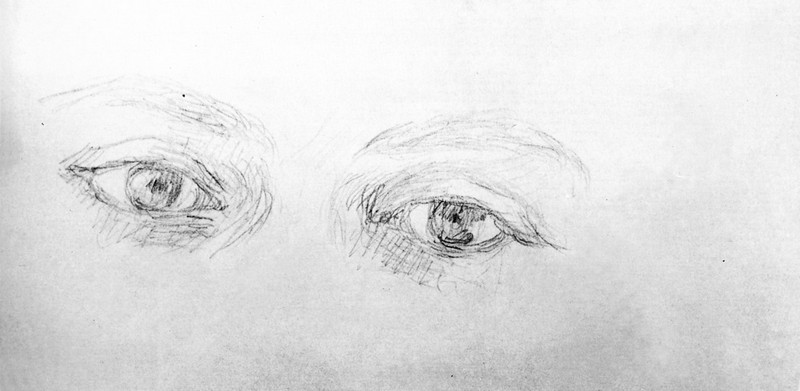
Drawing 11: A pencil drawing of The Mother's eyes (1935-40)
The Yogin's aim in the Arts
The Yogin's aim in the Arts should not be a mere aesthetic, mental or vital gratification, but, seeing the Divine everywhere, worshipping it with a revelation of the meaning of its works, to express that One Divine in god and men and creatures and objects.
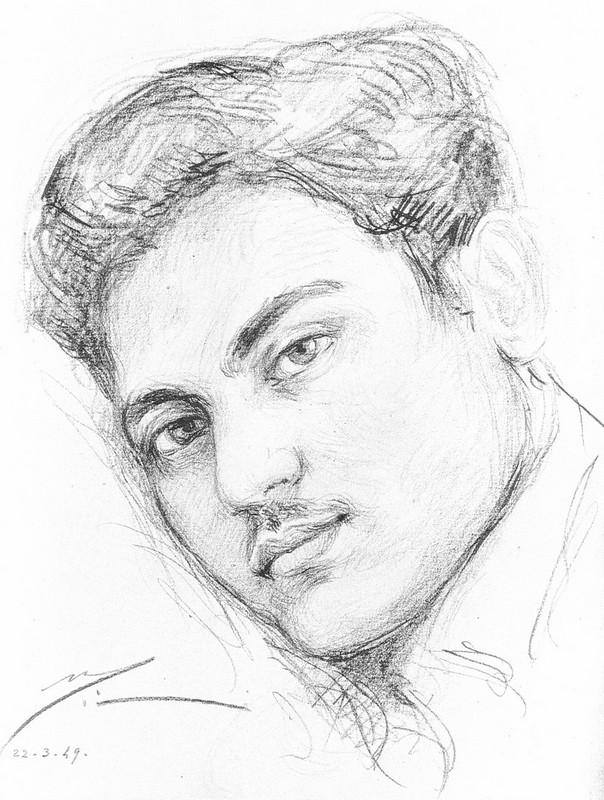
Drawing 51: Pencil drawing of Pranab on 22.March.1949
Art is a means, not an end
But when you are in Yoga, there is a profound change in the value of things, of Art as of everything else; you begin to look at Art from a very different standpoint. It is no longer the one supreme all-engrossing thing for you, no longer an end in itself. Art is a means, not an end; it is a means of expression. And the artist then ceases too to believe that the whole world turns round what he is doing or that his work is the most important thing that has ever been done. His personality counts no longer; he is an agent, a channel, his art a means of expressing his relations with the Divine.
O Lord of Beauty..
In the world of forms a lack of Beauty is a fault as great as a lack of Truth in the world of ideas. For Beauty is the homage which Nature renders to the Supreme Master of the universe; Beauty is the divine language in the form. A consciousness of the Divine which is not externally translated by an understanding and an expression of Beauty would be an incomplete consciousness.
But true Beauty is as difficult to discover, to understand and, above all, to live as any other expression of the Divine; this discovery and this expression demand as much impersonality and abdication of egoism as the discovery of Truth and Bliss. Pure Beauty is universal, and one must be universal in order to see and recognise it.
O Lord of Beauty, how many faults I have committed against Thee, how many faults I still commit!... Give me a perfect understanding of Thy Law, so that I may no longer fall short of it. Love would be incomplete without Thee; Thou art one of its most perfect ornaments, Thou art one of its most harmonious smiles. Sometimes I have misunderstood Thy role, but in the depth of my heart I have always loved Thee. And even the most arbitrary, the most radical doctrines have not been able to extinguish the fire of the cult which, since my childhood, I have vowed to Thee.
Thou art not what a vain people think of Thee, Thou art not exclusively attached to any particular form of life: it is possible to awaken Thee, to make Thee shine in every form; but for this one must have discovered Thy secret.
O Lord of Beauty, give me a perfect understanding of Thy Law, that I might not fail in it and that Thou mayst become in me the harmonious crown of the Lord of Love.
.jpg)